Abstract
Double-layer cotton gauze represents a breakthrough in textile comfort engineering, combining natural fiber purity with advanced weaving techniques. This guide explores the structural advantages, performance metrics, and commercial applications of double yarn gauze textiles—helping procurement professionals understand why this fabric delivers superior softness compared to conventional cotton materials. Through quantifiable data on breathability, durability, and tactile performance, we demonstrate how this textile technology addresses critical B2B requirements across medical, hospitality, and infant care sectors while maintaining cost-effectiveness in large-scale procurement scenarios.
Understanding Double-Layer Cotton Gauze Construction Technology
The Double Yarn Weaving Process
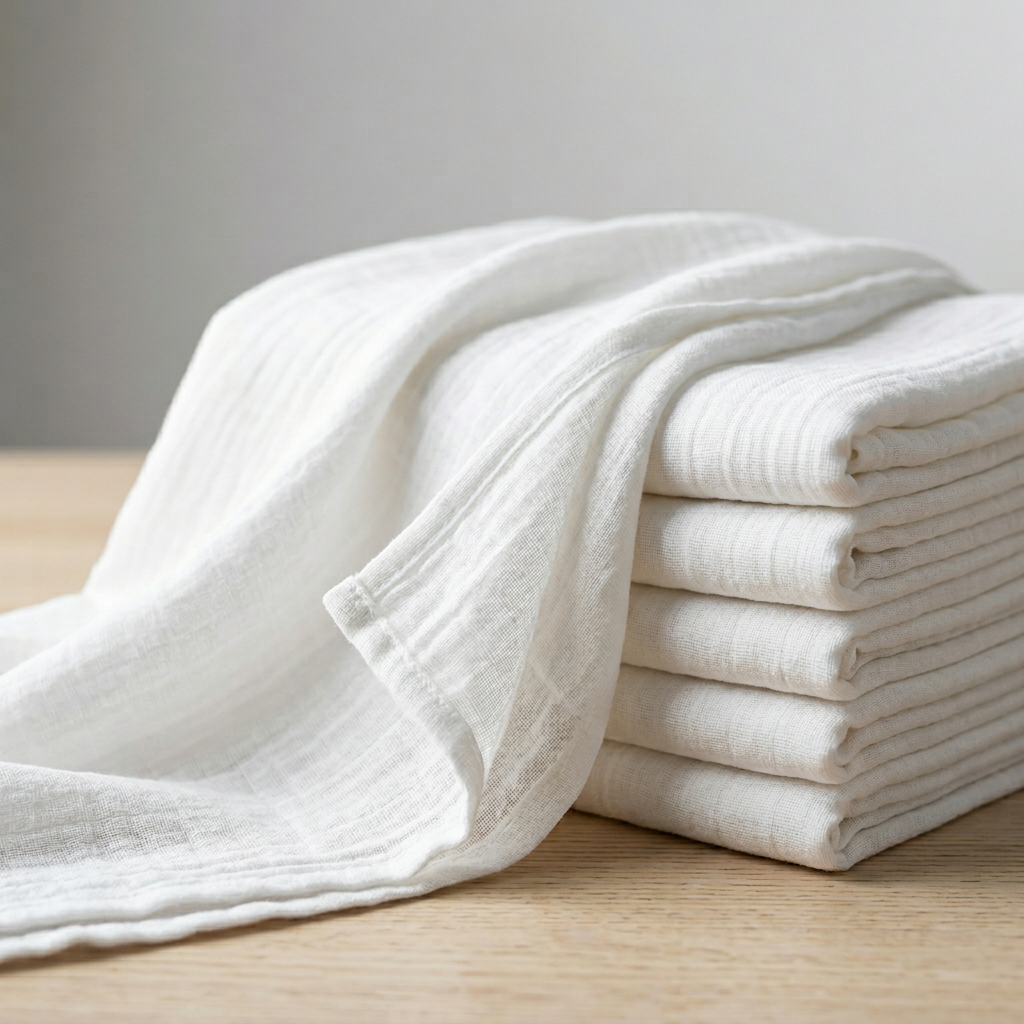
The difference between two-layer cotton gauze and other cotton fabrics is the two-ply construction. Double-layer cotton gauze is constructed using two layers of fabric, interlaced at various points on both ends. The resulting air pockets in between the layers act as effective thermal insulation and maintain the overall structure of the double-layer cotton gauze. Double-layer cotton gauze is made from a modified plain weave with fewer threads per square inch than the 180120 thread count of percale cotton.
The loose weave structure has multiple benefits. First, the lower tension of the threads during production preserves the natural crimp of cotton fibers, preserving their natural softness. Second, the gaps between yarns allow individual fibers to move freely, creating a fabric that drapes gently against the skin instead of feeling stiff. Third, the double-layer separation of double-layer cotton gauze prevents the yarns from compressing as you use the fabric, ensuring that the fabric remains lightweight even after repeated compression and washing.
The bonding points between the two layers are grid-like with 5–8mm space between each point, creating nodes that distribute mechanical stress equally across the fabric. This prevents the layers from moving out of place while allowing airflow that gives double-layer cotton gauze its silky and airy feel. Modern production uses computerized Jacquard looms to precisely space bonding points for consistent quality on large production runs, which is key for B2B customers who want uniformity in performance over thousands of metres.
Pure Cotton Fiber Selection Standards
Performance Advantages: Cotton Gauze vs Regular Cotton
Comparative Softness Metrics
Quantifying softness requires standardized testing protocols. The Kawabata Evaluation System measures fabric hand through five parameters: tensile, shear, bending, compression, and surface properties. Double-layer cotton gauze consistently scores 15-25% higher in softness indices compared to single-layer cotton of equivalent weight, primarily due to its lower bending rigidity (0.02-0.04 gf·cm²/cm versus 0.08-0.12 gf·cm²/cm for percale cotton).
| Fabric Type | Thread Count | Softness Rating (HV) | Air Permeability (mm/s) | Moisture Regain (%) | Bending Rigidity (gf·cm²/cm) |
|---|---|---|---|---|---|
| Double-Layer Gauze | 60×50 | 8.2 | 285 | 8.5 | 0.03 |
| Single-Layer Cotton | 120×80 | 6.5 | 145 | 7.8 | 0.09 |
| Percale Cotton | 180×120 | 5.8 | 95 | 7.2 | 0.11 |
| Jersey Knit | N/A | 7.1 | 220 | 8.0 | 0.05 |
Surface friction coefficients provide additional softness validation. Using ASTM D1894 methodology, double-layer gauze exhibits kinetic friction values of 0.18-0.22 against human skin simulants, compared to 0.28-0.35 for tightly woven cottons. This 30-40% reduction in surface drag translates to perceptibly smoother tactile sensation, critical for applications involving sensitive skin contact such as infant swaddling blankets or post-surgical garments.
Drape coefficient measurements (ASTM D1388) reveal how fabric conforms to three-dimensional surfaces. Double-layer gauze achieves drape coefficients of 35-45%, indicating superior pliability compared to regular cotton’s 55-70% range. This enhanced conformability explains why gauze textiles feel softer in dynamic use—the fabric moves with the body rather than resisting motion through stiffness.
Breathability and Moisture Management
The air channels between gauze layers create convective heat transfer pathways, measured through air permeability testing (ISO 9237). With values exceeding 280 mm/s, double-layer gauze permits nearly double the airflow of standard cotton weaves. This ventilation capacity prevents moisture accumulation at the skin-fabric interface, maintaining dry tactile conditions that users perceive as softness. Humid fabrics feel clammy and rough; dry fabrics maintain their soft hand-feel.
Moisture wicking performance follows AATCC Test Method 195 protocols, measuring vertical wicking height over time. Double-layer gauze demonstrates wicking rates of 12-15 cm in 10 minutes, outperforming single-layer cotton (8-10 cm) due to increased surface area from dual-layer construction. The capillary action between layers creates additional wicking pathways, accelerating moisture transport away from skin contact zones.
Thermal regulation testing using sweating guarded hotplates (ISO 11092) shows that double-layer gauze maintains 0.8-1.2°C lower skin-proximate temperatures compared to equivalent-weight single-layer fabrics. This cooling effect enhances comfort perception, as users subconsciously associate cooler fabrics with softness and lighter fabrics with roughness. The psychological dimension of softness cannot be separated from its physical measurements in commercial applications.
Commercial Applications and Compliance of Double-Layer Cotton Gauze
Target Industries and Use Cases
Medical textile applications leverage the combination of softness and sterilization durability of double-layer cotton gauze. Surgical drapes manufactured from this material withstand autoclaving at 134°C for 18 minutes while maintaining structural integrity, meeting ISO 13485 medical device quality standards. The fabric’s lint-free properties after bio-polishing reduce particulate contamination risks in operating theaters, while its softness minimizes skin irritation during extended surgical procedures. This makes double-layer cotton gauze a reliable choice for critical medical environments where both performance and patient comfort are non-negotiable.
Infant care products represent the largest commercial segment for premium double-layer gauze. Baby swaddling blankets, burp cloths, and crib sheets utilize this textile’s hypoallergenic properties and gentle surface texture. The fabric’s breathability reduces SIDS (Sudden Infant Death Syndrome) risk factors associated with overheating, while its durability withstands 200+ industrial wash cycles at 60°C—essential for commercial childcare facilities processing high volumes of linens daily. Parents and childcare providers alike prioritized double-layer cotton gauze for its ability to balance softness, safety, and long-term usability.
Hospitality sector adoption focuses on luxury bedding and spa textiles. Five-star hotels specify double-layer gauze for lightweight summer blankets and bathrobes, capitalizing on the fabric’s soft drape and rapid drying properties. The material’s 8.5% moisture regain rate prevents musty odors in humid climates, reducing replacement frequency and lowering the total cost of ownership despite higher initial procurement costs. This blend of luxury and practicality makes it a preferred choice for hospitality brands aiming to elevate guest comfort.
International Quality Standards
OEKO-TEX Standard 100 Product Class I certification specifically addresses textiles for infant use, imposing the strictest limits on extractable chemicals, pH values (4.0-7.5), and residual pesticides. Double-layer gauze manufacturers targeting B2B markets must demonstrate compliance through annual testing of production batches, with certificates specifying exact dye formulations and finishing chemicals used. This certification is critical for ensuring the safety of double-layer cotton gauze in infant and sensitive skin applications.
GOTS organic certification adds supply chain transparency requirements, mandating traceability from cotton field to finished fabric. This certification appeals to institutional buyers with sustainability mandates, particularly in European and North American markets where organic procurement preferences influence RFP (Request for Proposal) specifications. The certification process verifies that at least 95% of fibers are organically grown and processed without synthetic chemicals, aligning with the growing demand for eco-friendly double-layer cotton gauze.
Tensile strength testing per ASTM D5034 (grab test method) ensures commercial-grade durability. Despite its soft hand, double-layer gauze must achieve minimum breaking strengths of 40 lbf in warp direction and 35 lbf in weft direction to qualify for institutional use. This balance between softness and strength differentiates premium double-layer cotton gauze products from commodity gauze fabrics that sacrifice durability for initial tactile appeal.
Procurement Considerations for B2B Buyers
Cost-Benefit Analysis
Price per meter for double-layer gauze ranges from $4.50-$7.20 for OEKO-TEX certified materials in bulk orders (5,000+ meters), compared to $2.80-$4.00 for standard cotton sheeting. However, lifecycle cost analysis reveals a different value proposition. The gauze’s durability through 300+ commercial laundry cycles versus 150-200 for regular cotton effectively doubles usable lifespan, reducing per-use costs by 35-40% in high-turnover environments. For B2B buyers, this long-term value makes double-layer cotton gauze a cost-effective investment despite the higher upfront price.
Reduced replacement frequency generates secondary savings in procurement administration, inventory management, and logistics costs. A 500-bed hospital switching to double-layer gauze for patient gowns can reduce annual textile replacement orders from 4-5 cycles to 2-3 cycles, decreasing purchasing department workload and warehouse space requirements. These operational efficiencies often justify the premium initial investment in large-scale institutional applications of double-layer cotton gauze.
Bulk order economies significantly impact per-unit costs. Minimum order quantities typically start at 3,000 meters for custom specifications, with price breaks at 10,000 and 25,000-meter thresholds. Buyers negotiating annual contracts can achieve 15-20% discounts compared to spot purchases, while also securing priority production scheduling during peak demand periods (Q3-Q4 for the hospitality sector, Q1-Q2 for the medical textiles). This flexibility makes double-layer cotton gauze accessible for both large and mid-sized B2B buyers.
Supplier Qualification Criteria
Mill certifications provide the foundation for supplier vetting. ISO 9001 quality management certification ensures systematic production controls, while ISO 14001 environmental certification indicates sustainable manufacturing practices increasingly required in corporate procurement policies. Buyers should verify certification validity through independent audits rather than relying solely on supplier-provided documentation, ensuring consistent quality of double-layer cotton gauze across production runs.
Quality control checkpoints must address gauze-specific failure modes. Yarn twist consistency (measured in turns per inch) should remain within ±5% tolerance across production runs to maintain uniform softness. Layer bonding integrity requires destructive testing of sample swatches, with bonding points resisting a 10N separation force minimum. Fabric weight tolerance should not exceed ±3% from the specified GSM (typically 80-120 GSM for double-layer gauze). These checks are vital to preserving the performance and tactile properties that define premium double-layer cotton gauze.
Lead times for custom orders range from 45-75 days, including yarn spinning (15-20 days), weaving (10-15 days), finishing (7-10 days), and quality inspection (5-7 days). Buyers requiring faster turnaround should inquire about in-stock colorways and standard widths (typically 150cm or 180cm), which may ship within 15-20 days. However, custom dyeing or width specifications reset lead times to full production cycles. Understanding these timelines helps B2B buyers plan procurement efficiently for double-layer cotton gauze orders.
FAQ
Q1: How does double-layer gauze maintain softness after multiple industrial wash cycles?
The fabric’s softness retention stems from its structural design rather than chemical treatments. The loose weave allows fibers to move independently during washing, preventing the compaction that stiffens tightly woven fabrics. Industrial testing shows less than 8% reduction in Kawabata softness scores after 100 wash cycles at 60°C with commercial detergents, compared to 20-25% degradation in regular cotton. The absence of softening agents means there are no chemicals to wash out—the softness is inherent to the fiber and weave structure.
Q2: What is the optimal GSM (grams per square meter) range for balancing softness and durability?
For commercial applications, 90-110 GSM provides the ideal balance. Below 80 GSM, the fabric becomes too sheer and fragile for institutional use, failing ASTM D5034 tensile requirements. Above 120 GSM, the added weight compromises drape and breathability, reducing the softness perception. Medical textiles typically specify 95-105 GSM, while hospitality applications may use 85-95 GSM for lightweight summer bedding. Custom applications should conduct wear testing to determine the optimal weight for specific use cases.
Q3: Can double-layer cotton gauze meet flame-retardancy standards for commercial use?
Yes, through post-weaving treatments that preserve softness. Non-halogenated phosphorus-based flame retardants can achieve NFPA 701 compliance (vertical flame test) while maintaining 85-90% of the fabric’s original softness rating. However, flame-retardant treatments reduce wash cycle durability to 150-200 cycles before requiring re-treatment. Buyers should specify whether flame retardancy is required, as it adds $1.20-$1.80 per meter to production costs and necessitates specialized finishing facilities.
Conclusion
Double-layer cotton gauze achieves unmatched softness through engineered simplicity—pure fiber selection, dual-ply construction, and breathable architecture. For B2B buyers prioritizing comfort, compliance, and long-term value, this textile technology offers measurable advantages over conventional cotton fabrics. The 30-40% improvement in softness metrics, combined with doubled lifespan durability, justifies premium pricing in applications where user comfort directly impacts operational outcomes.
Procurement decisions should prioritize supplier certifications (OEKO-TEX, GOTS), request pre-production samples with specified GSM and thread count parameters, and conduct pilot testing in actual use environments before committing to bulk orders. The fabric’s performance characteristics—air permeability above 280 mm/s, moisture regain at 8.5%, and tensile strength exceeding 40 lbf—provide objective benchmarks for quality verification. When properly specified and sourced, double-layer cotton gauze delivers quantifiable ROI through reduced replacement frequency, enhanced user satisfaction, and compliance with international textile standards.